Complete Reverse Engineering
Reverse Engineering Services for Existing Crane Systems and Components
Measurement, redesign and redevelopment of crane parts or systems
Reverse engineering of obsolete or unavailable crane components recreating accurate replacement parts from existing components when original drawings and OEM supply are no longer available.
Expert Care and Support Solution for Your Industrial
Cranes and Material Handling Equipment
Reverse engineering of obsolete or unavailable crane components. When original drawings, OEM support, or spare parts are unavailable, Tacklers recreates components from existing parts, enabling replacement without reliance on the original manufacturer.
Scope of Inspection
- Failed or worn component physical condition assessment
- Dimensional measurement and geometry capture
- Material type and specification identification
- Manufacturing process and tolerance requirement assessment
- Functional performance requirement definition
- Quality assurance and testing requirement specification
Deliverables
- Reverse-engineered component specification and drawing
- Material and manufacturing process specification
- Fabricated replacement component with quality documentation
Get Your Custom AMC Plan Today
Outcome
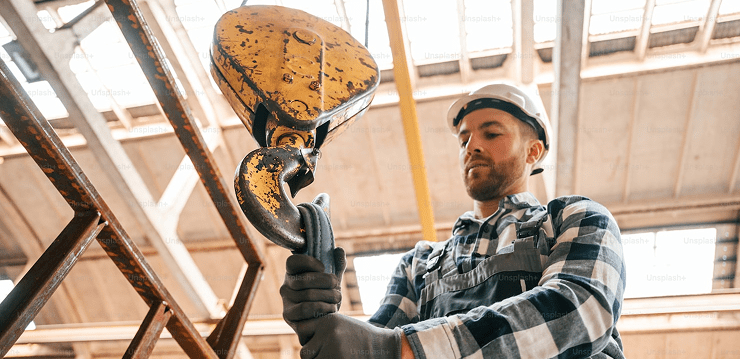
- Obsolete component replaced with quality-assured equivalent
- Crane returned to service without OEM dependency
- Full dimensional and material documentation for future reference
A Structured Approach to Complete Reverse Engineering
Performance and upgrade challenges typically develop through changing production demands, ageing systems, and evolving safety standards.
Our structured approach identifies the right solution, assesses feasibility, quantifies ROI, and delivers measurable improvements in crane performance and reliability.
1. Safety Risk Assessment
Assessment of Component Condition and Functional Requirements
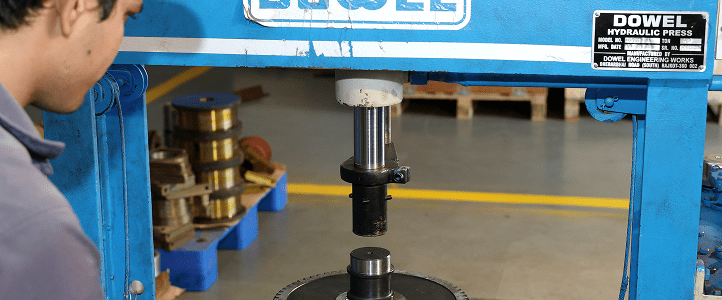
Reverse engineering begins with a thorough assessment of the existing component to understand its functional role, current condition, and the performance requirements the replacement must meet.
Key Activities:
- Physical condition assessment of component to be reverse engineered
- Functional role and performance requirement definition
- Identification of interfaces and mating component requirements
- Safety and load-bearing requirement assessment
- Documentation of reverse engineering scope and objectives
This step creates a baseline risk profile of the crane system.
Flow to Next Step:
The functional requirements and condition assessment drive the detailed dimensional measurement and material analysis in the on-site evaluation step.
2. On-Site Evaluation
Dimensional Measurement, Material Analysis, and Drawing Creation
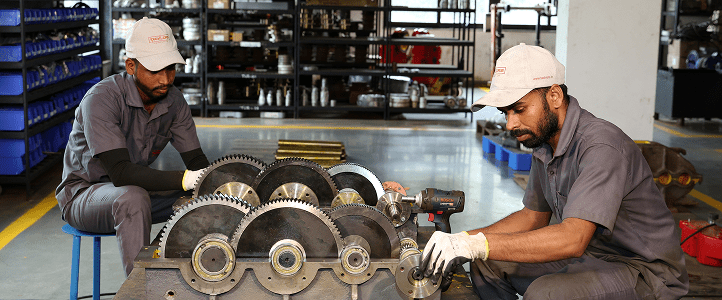
The component is fully measured and analysed on-site or in workshop to capture all dimensions, geometry, material specification, and manufacturing process requirements.
Key Activities:
- Complete dimensional measurement using precision instruments
- Material type identification hardness testing and spectral analysis
- Tolerance and surface finish requirement assessment
- Engineering drawing creation from measurement data
This step connects the technical condition with actual usage patterns.
Flow to Next Step:
The reverse-engineered drawing and material specification define the fabrication cost and quality assurance requirement in the next step.
3. Cost & ROI Impact
Cost and Lead Time vs OEM or Alternative Supply
Reverse engineering cost and lead time are evaluated against OEM supply where available and alternative sourcing options confirming the most practical and cost-effective replacement approach.
Key Activities:
- Reverse engineering cost vs OEM or alternative part cost
- Lead time comparison across supply options
- Quality equivalence and performance risk assessment
- Downtime cost of waiting for alternative supply vs reverse engineering
This step defines what needs to be done and why it matters to operations.
Flow to Next Step:
The confirmed reverse engineering approach drives component fabrication, quality inspection, and delivery in the final step.
4. Delivery & Outcome
Component Fabrication, Quality Inspection, and Delivery
The reverse-engineered component is fabricated to drawing by qualified manufacturers, inspected against specification, and delivered with full quality documentation.
Key Activities:
- Component fabrication to reverse-engineered drawing and specification
- Dimensional inspection against drawing and tolerance requirements
- Material and process quality documentation
- Component delivery and installation support
This step creates a baseline risk profile of the crane system.
Result of the Approach
Action Plan and Long-Term Reliability Improvement
Tacklers complete reverse engineering service eliminates OEM dependency delivering quality-assured replacement components that restore crane availability when no other supply route exists.
Key Activities:
- Obsolete component successfully replaced with engineered equivalent
- Crane availability restored without OEM supply dependency
- Full dimensional drawing and material documentation for future use
- Quality-inspected component meeting functional performance requirements
This step creates a baseline risk profile of the crane system.
Quick answers to questions that may interest you
Can't find what you're looking for? Talk to our expert for your requirements.
Tacklers reverse engineering covers gearbox components, shafts, wheels, rope drums, structural brackets, castings, and most mechanical crane components where original drawings or OEM supply are no longer available.
Reverse-engineered components are manufactured to the measured dimensions and material specification of the original, with tolerance and surface finish matched to functional requirements — delivering equivalent performance to the original part.
Lead time depends on component complexity and the manufacturing process required. Simple components can be turned around in days. Complex castings or precision gears require longer lead times. Our team will advise after the initial assessment.
Need Reliable Lifting Solutions?
Talk to Us
Corporate Office & HO:
Plot No. 5,6,7 Devraj Industrial Park, Piplaj-Pirana Road, Ahmedabad – 382405, India
Regd. Office & Plant:
Plot No. 613, Phase IV, G.I.D.C, Vatva, Ahmedabad – 382445, India.
Bengaluru Plant:
Plot No. 508, Sompura Industrial Area, Dobaspet, Bengaluru – 562111. India.