Maintenance & Repairs
Crane Maintenance and Repair Services for Continuous Operation
On-site repair and service support as per requirement
End-to-end repair solutions to restore crane performance, eliminate safety risks, and return equipment to full operational condition with minimum downtime.
Expert Care and Support Solution for Your Industrial
Cranes and Material Handling Equipment
A comprehensive crane health check is performed to evaluate the mechanical, structural, and electrical condition of the equipment. The goal is early fault detection, safety validation, and performance optimization
Scope of Inspection
- Structural and mechanical fault identification and assessment
- Hoist, gearbox, and lifting mechanism repair scope evaluation
- Brake, wheel, and travel system repair assessment
- Electrical system fault diagnosis and repair scope
- Safety device and limit switch condition and repair review
- Post-repair load test and performance verification scope
Deliverables
- Detailed fault report with repair scope and cost estimate
- Quality-assured repair execution plan
- Post-repair test and performance verification documentation
Get Your Custom AMC Plan Today
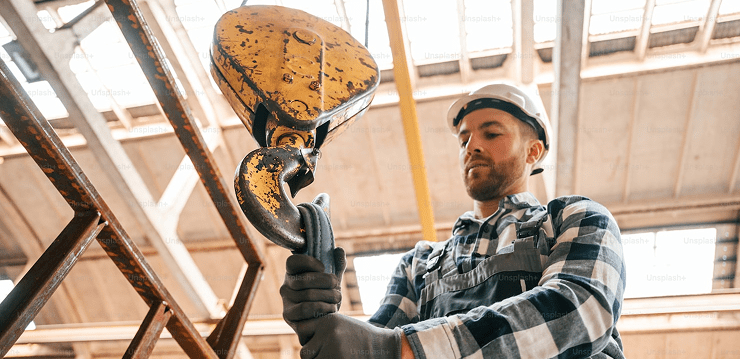
Outcome
- Restored crane performance and operational reliability
- Eliminated safety risks from identified faults
- Minimized downtime with efficient repair execution
A Structured Approach to Crane Maintenance and Repairs
Crane performance issues typically develop gradually due to wear, misalignment, load cycles, and environmental conditions. .
Our structured evaluation process identifies risks early, understands real operating conditions, and delivers measurable improvements in reliability.
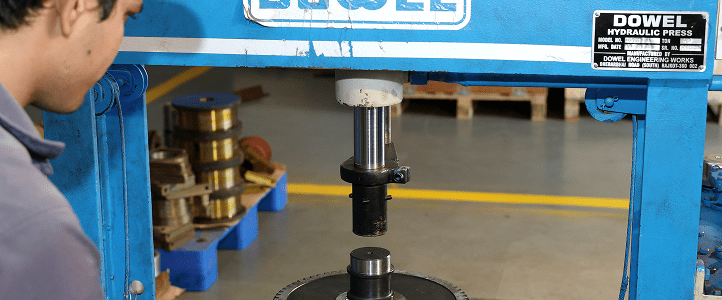
1. Safety Risk Assessment
Identification of Faults and Safety Risks in Damaged Components
The repair process begins with a comprehensive fault and safety risk assessment to identify all damaged, failed, or safety-compromised components before repair work commences.
Key Activities:
- Visual and operational inspection of all crane systems
- Identification of failed, damaged, and worn components
- Safety risk assessment of all identified faults
- Structural inspection of girders, joints, and connections
- Electrical and control system fault identification
This step creates a baseline risk profile of the crane system.
Flow to Next Step:
The fault and safety risk assessment establishes the full repair scope and informs the on-site diagnostic evaluation in the next step.
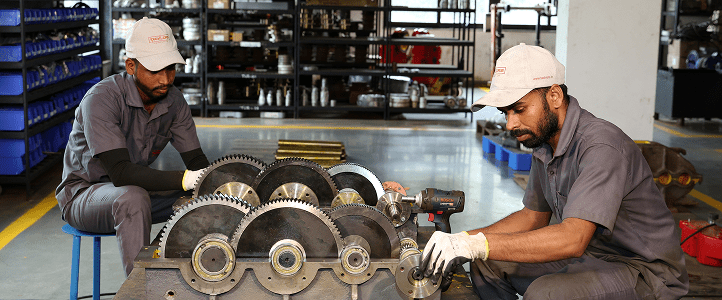
2. On-Site Evaluation
On-Site Diagnosis of Mechanical and Electrical Failures
All mechanical and electrical faults are diagnosed on-site under operating conditions to confirm root causes and define the complete repair scope.
Key Activities:
- Mechanical fault diagnosis hoist, gearbox, brakes, and wheels
- Electrical fault diagnosis controls, wiring, and motors
- Root cause identification for each confirmed fault
- Documentation of complete repair scope and parts requirement
This step connects the technical condition with actual usage patterns.
Flow to Next Step:
The complete diagnostic findings define the repair cost, downtime impact, and business case for repair vs replacement in the next step.
3. Cost & ROI Impact
Minimizing Downtime Impact on Operations
Repair cost and timeline are evaluated against the production downtime cost and risk of continued operation prioritising repairs and minimising total impact on operations.
Key Activities:
- Downtime cost analysis and production impact assessment
- Repair cost vs component replacement cost comparison
- Prioritisation of repairs by safety and operational impact
- Repair timeline planning to minimise production disruptio
This step defines what needs to be done and why it matters to operations.
Flow to Next Step:
The repair priority plan and cost approval drive execution with quality assurance and testing in the final step.
4. Delivery & Outcome
Execution of Repairs with Quality Assurance and Testing
All repairs are executed by qualified engineers with quality assurance inspection and performance testing before the crane is returned to service.
Key Activities:
- Quality-assured execution of all approved repairs
- Component replacement with genuine or equivalent parts
- Post-repair inspection and quality verification
- Performance and load testing before return to service
This step creates a baseline risk profile of the crane system.
Result of the Approach
Action Plan and Long-Term Reliability Improvement
Tacklers end-to-end repair services restore crane performance and eliminate safety risks delivering a reliable, tested, and documented return to service.
Key Activities:
- All identified faults repaired with quality assurance verification
- Safety risks eliminated with inspected and tested components
- Crane returned to full operational performance and reliability
- Complete repair documentation for equipment maintenance records
This step creates a baseline risk profile of the crane system.
Quick answers to questions that may interest you
Can't find what you're looking for? Talk to our expert for your requirements.
Tacklers crane repair services cover structural repairs, hoist and gearbox repairs, brake and wheel replacement, electrical and control system repairs, rope and chain replacement, and safety device repair across all crane types and brands.
Response time depends on location and repair type. Our team will confirm an estimated response time when you contact us. Emergency breakdown response is available for critical production situations.
Yes. All Tacklers crane repairs include post-repair inspection and performance testing before the crane is returned to service. Load testing is conducted where required by the nature of the repair.
Need Reliable Lifting Solutions?
Talk to Us
Email:
Corporate Office & HO:
Plot No. 5,6,7 Devraj Industrial Park, Piplaj-Pirana Road, Ahmedabad – 382405, India
Regd. Office & Plant:
Plot No. 613, Phase IV, G.I.D.C, Vatva, Ahmedabad – 382445, India.
Bengaluru Plant:
Plot No. 508, Sompura Industrial Area, Dobaspet, Bengaluru – 562111. India.